In a community where access to education remains a challenge, JCI Manila’s Baby Jaycee team delivers more than a school. It helps build a future where children can learn, dream, and grow in peace.
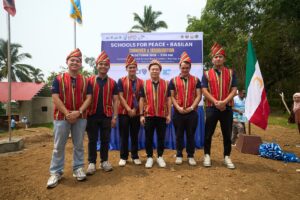
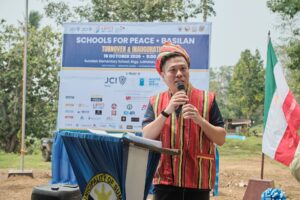
On Friday, October 16, 2026, 28 JCI Manila brothers led by President Edison Ke and Project Chairman Emilio Ejercito traveled by air, land, and sea to Sumisip, Basilan, for the turnover of a new solar-powered elementary school under Schools for Peace, a community development initiative aimed at creating better opportunities for children in one of the country’s most remote and challenging communities.
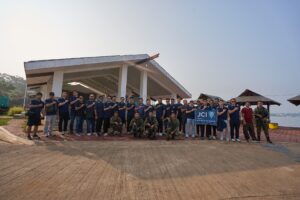
Reaching the project site was already a journey that underscored the significance of the mission. In an area where security concerns have long shaped daily life, travel requires careful coordination, military escorts, and strict precautions. Upon arrival in Basilan, the delegation was welcomed by Mayor Julz Hataman and escorted by military personnel to the community in Sumisip, where the new school stood ready to welcome its first students.
Yet beyond the journey and the security arrangements was a purpose that brought everyone together: giving children a safe, proper place to learn and the opportunity to imagine a future beyond the circumstances into which they were born.
Schools for Peace marks the second installment of what JCI Manila hopes will become a long-term community development program in Basilan. It follows the organization’s continuing efforts to support communities through initiatives designed to address the conditions that can leave young people vulnerable to recruitment by armed groups. The broader vision also includes Farms for Peace, which seeks to help build sustainable livelihoods and provide families with more opportunities for a better future.
The community served by the project includes local residents as well as children of former Abu Sayyaf members who surrendered to the government. For these children, access to education represents more than a classroom. It offers a chance to grow up with greater stability, dignity, and hope.
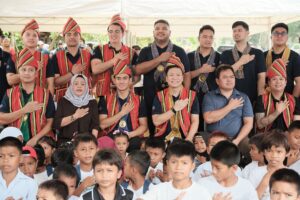
The new solar-powered elementary school, built to accommodate up to 100 students, was provided for the Hataman community with the support of local government partners and other key individuals who helped make the project possible. Among those who assisted in coordinating the initiative were NED Henzberg Austria and Member of Parliament Rasul Ismael.
For the children, the difference was immediate and tangible. They would no longer have to attend classes in muddy and inadequate surroundings. Instead, they could look forward to learning in a proper school building designed to provide a more suitable environment for their education.
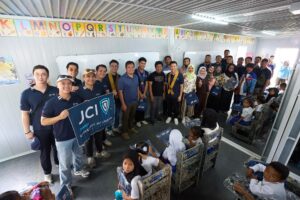
During the turnover ceremony, Ms. Myra B. Mangkabung, Ed.D., CESE, Superintendent of the Ministry of Basic, Higher and Technical Education (MBHTE), expressed her gratitude for the initiative. She described the school as an exceptional addition to the educational facilities in Basilan and shared how excited the children were to finally have a classroom they could be proud of.
Her message reflected the importance of the project beyond its physical structure. A school may be built from concrete, steel, and other materials, but its true value lies in the opportunities it creates for the students who will fill its classrooms.
Governor Mujiv Hataman likewise expressed appreciation for the continued partnership, highlighting the speed and quality of the school’s construction. While school-building projects in the community can take more than three years to complete, the JCI Manila Baby Jaycee team helped deliver this prefabricated solar-powered facility in just two months, with the actual construction completed in only 26 days.
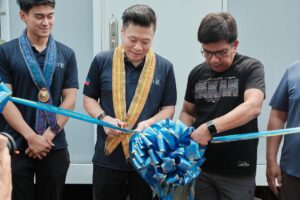
The achievement was made possible through a partnership that brought together different sectors for a shared purpose. The local government unit provided trucks and logistical support, while JCI Manila supplied the funding and technical know-how. Remarkably, members of the former Abu Sayyaf community contributed manpower to the actual construction.
It was a powerful demonstration of what cooperation can accomplish when people work toward a common goal. Local government, civic leaders, and members of a community affected by conflict came together to build something that would serve its youngest generation.
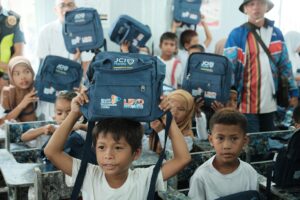
The school was also accompanied by the distribution of new school bags for the children, ensuring that they would have something practical to carry as they began their next chapter. For many of the students, these simple gifts carried enormous meaning. A new school bag and a proper classroom might be ordinary sights elsewhere, but in a remote community where resources remain scarce, they represent a welcome change.
The program concluded with closing remarks from President Edison Ke, followed by a hearty Jollibee lunch for the children and attendees. The meal became another memorable part of the day. Some of the children had never tasted Jollibee before, as the community’s remote location makes access to many everyday conveniences difficult.
Their excitement over the food offered a humbling reminder that what people in more accessible communities may take for granted can be a special experience elsewhere. Their smiles were not simply reactions to a new building, school supplies, or a meal. They reflected the joy of being seen, supported, and given something to look forward to.
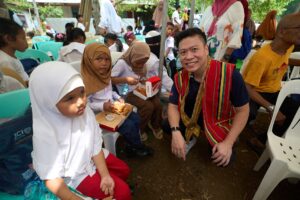
Behind the successful delivery of Schools for Peace was a team of young leaders who embraced the challenge of turning an ambitious vision into reality. Under the guidance of Director Rocky Cebrero for Special Projects and Government Affairs and Vice President for Community Affairs Francis Deo, the Baby Jaycee team was led by Project Chairman Emilio Ejercito, alongside Paco Rabat, Patrick Cillo, Al Jerom Santos, and James Ricohermoso.
Their work demonstrated that leadership is not measured solely by the scale of a project, but by the willingness to take responsibility for making it happen. Coordinating resources, working with local partners, overcoming logistical challenges, and delivering a functional school in a matter of weeks required commitment, collaboration, and a clear understanding of the people the project was meant to serve.
Schools for Peace is envisioned as the beginning of a sustained effort, not a one-time intervention. With Farms for Peace and other community development initiatives following the same purpose, JCI Manila hopes to help create conditions in which children and families can find opportunities closer to home and build lives shaped by possibility rather than conflict.
In Basilan, the impact of the day could be seen in the simplest moments: children eager to enter their new classrooms, proudly holding their school bags, and smiling over a meal they had never experienced before. These moments put the meaning of service into perspective.
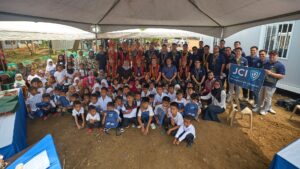
For the brothers of JCI Manila, the journey to Sumisip was more than a project turnover. It was a reminder that leadership means going beyond familiar places, confronting difficult challenges, and working alongside communities to build a better future.
The school may have taken only 26 days to construct, but the hope it represents is intended to last far longer. And for the children who will soon fill its classrooms, the true legacy of Schools for Peace will be measured not in the speed of its construction, but in the opportunities it opens for generations to come.
This is what it means to Lead Beyond: to travel farther, work together, and turn the promise of a better future into something children can see, touch, and experience for themselves.
SEO by SEO-Hacker. Optimized and maintained by Sigil
© 2026 Asian Pearl. JCI Manila Official Publication. All Rights Reserved.