For many JCI members, bid writing begins only when deadlines are near.
Slides are rushed. Photos are gathered at the last minute. Narratives are stitched together overnight. Somewhere in the process, the project itself slowly becomes secondary to the presentation.
But during Beyond Accomplishments: Writing Award-Winning JCI Bids, held last May 13, JCI Manila members were reminded that strong bids are not merely about trophies or aesthetics. They are about credibility, documentation, storytelling, and organizational memory.
Hosted by JCI Manila Vice President for Internal Affairs Jet Tatel, the learning session gathered members at the headquarters of TKL Steel Corporation for an evening focused on sharpening one of the organization’s most quietly influential skills.
The event was organized by the Membership Benefits and Partnerships Directorate under Director Clifford Aw, with Javi Veneracion serving as organizing committee chairman.
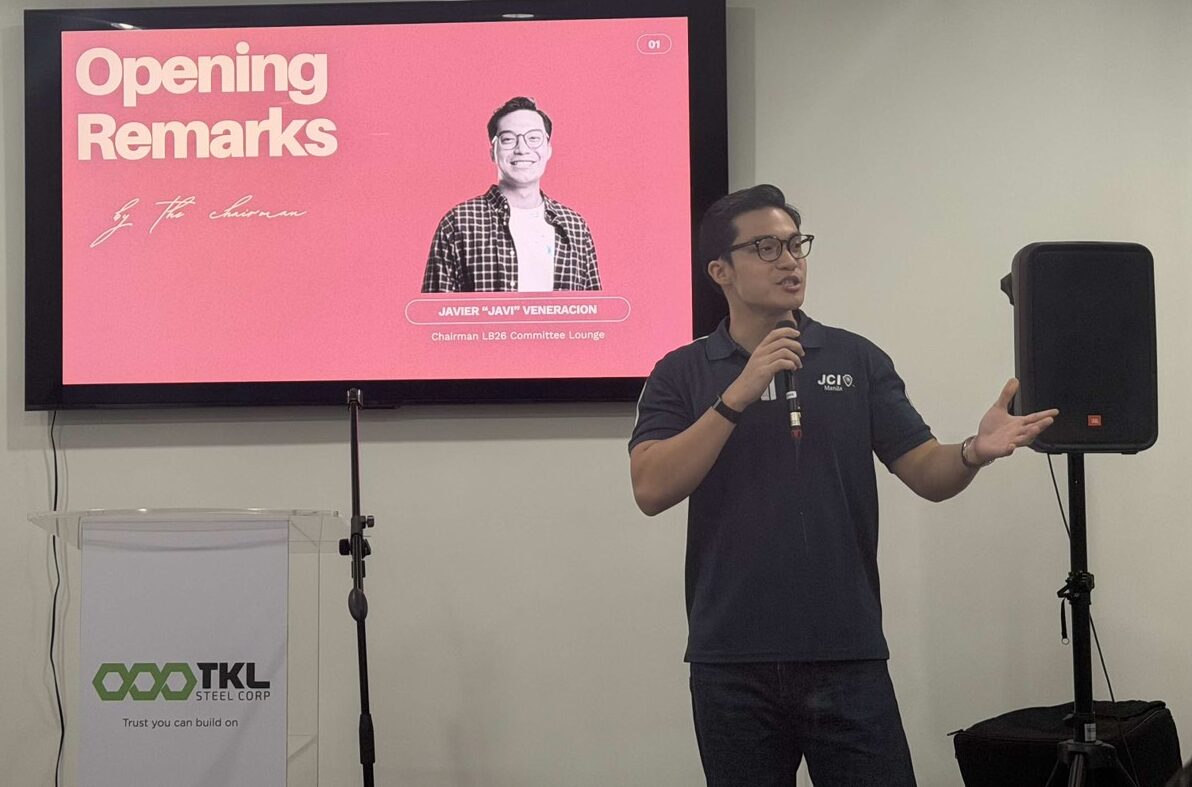
Project Chairman Javi Veneracion giving the opening remarks.
The session featured talks from Executive Vice President Matt Flores, Secretary General Bobbit Castro, and JCI Manila member and 2022 Metro South Regional Skills Development Director (RSDD) Clarence Santos, whose presentation titled Bid Writing Made Practical became one of the event’s central highlights.
RSDD Clarence immediately framed the discussion not as a lecture from a distant expert, but as someone deeply immersed in the process itself.
“I’ve been a JCI Manila member since 2019, and every year, I’ve written at least one bid,” he shared during the presentation.
That experience shaped the tone of the discussion. Rather than treating bids as decorative submissions meant only for competitions, RSDD Clarence emphasized that strong bids reflect how an organization thinks, plans, documents, and executes.
“Today, I want you all to understand why you should write bids, and hopefully, to write winning ones every year,” he added.
Trust Before Design
One of the strongest recurring themes throughout the session was trust.

RSDD Clarence Santos giving a session on writing award-winning bids.
RSDD Clarence argued that judges often decide whether they believe a project long before they finish reading the bid itself. For him, credibility is not built through grand claims alone, but through transparency and documentation.
“Doubt breaks trust. Broken trust loses bids,” he bluntly stated.
The presentation repeatedly stressed the importance of complete financial accountability, especially for projects involving sponsorships and fundraising.
“Pag proud kang naka-secure ka ng X amount mula sa sponsor, ipakita mo kung paano nyo ginastos yun,” RSDD Clarence noted, warning that projects with “unallocated funds” become immediate red flags for judges.
The point resonated beyond competitions.
In many ways, the session quietly argued that good bid writing is also good governance.
Receipts. Planning meetings. Beneficiary engagement. Sponsor coordination. These were not treated as optional attachments, but as proof that projects truly existed beyond stage photos and social media captions.
“Hindi lang selfies,” the presentation emphasized. “Gusto ko makita ang planning process.”

Writing for Real Readers
Another major lesson centered on readability.
RSDD Clarence openly acknowledged a reality many participants found both funny and painfully accurate.
“Remember, maraming tamad magbasa,” he said.
The line drew laughter inside the room, but it carried a practical insight. Layout and writing should naturally guide judges toward key information instead of overwhelming them with cluttered pages and dense paragraphs.
“The layout designer’s job is to direct the reader’s eyes to read all key information,” the presentation explained.
In competitions where judges review numerous submissions consecutively, clarity itself becomes strategic.
Speaking the Language of JCI
One of the more interesting portions of the presentation involved what RSDD Clarence jokingly referred to as the “secret sauce” of bid writing: keywords, soundbites, and organizational context.

The deck encouraged writers to naturally incorporate familiar JCI language into their narratives, including references to frameworks, slogans, and the United Nations Sustainable Development Goals.
“Sprinkle JCI-sounding phrases,” he advised, citing examples such as references to the Active Citizen Framework and UNSDGs.
But RSDD Clarence clarified that this was not simply about forcing buzzwords into paragraphs.
Instead, he argued that understanding organizational language demonstrates immersion within the movement itself.
“Gamitin ang slogan ng chapter mo kung applicable,” he stated. “This shows na alam mo ang context kung saan ka nagsusulat. Na active and involved JCI member ka.”
A Venue Built for Learning
The evening itself also left an impression on attendees. Held at the headquarters of TKL Steel Corporation, the venue surprised many members with its modern interiors, amenities, and overall finish.

The actual hall drew comparisons to well-known co-working spaces, blending a professional corporate atmosphere with the comfort and polish typically associated with contemporary collaborative workspaces.
For participants, the setting reflected the evolving culture of JCI Manila itself: increasingly professionalized, detail-oriented, and intentional about the environments where learning and leadership conversations happen.
Beyond Awards
Underneath the practical advice, the session ultimately revealed something larger about JCI culture.
Bid writing was presented not merely as a competition requirement, but as a discipline that preserves institutional memory. Projects end. Committees dissolve. Events fade. But well-written bids preserve the reasoning, execution, impact, and lessons behind those initiatives. In many ways, they become historical documents.
The session “Beyond Accomplishments: Writing Award-Winning JCI Bids” reflected exactly that philosophy: that leadership is not only about creating impact, but also about documenting it well enough for future generations to understand, replicate, and improve upon it.
SEO by SEO-Hacker. Optimized and maintained by Sigil
© 2026 Asian Pearl. JCI Manila Official Publication. All Rights Reserved.