Editor’s note: This article reflects Asian Pearl’s independent analysis of data compiled and presented by Executive Treasurer Joshua Aragon. As with any interpretation, the conclusions drawn may be right or wrong and do not necessarily reflect his personal views.
The numbers look strong on paper.
JCI Manila counts nearly 500 regular members and over 300 associates. Many are founders, executives, and decision-makers working within Metro Manila’s key economic zones. They build companies, finance projects, and operate in industries that shape the country’s direction.
But a closer look at the data tells a more complex story.
The figures, compiled and presented by Executive Treasurer Joshua Aragon during the BUILD Philippines General Membership Meeting on April 21 at Marco Polo Ortigas Manila, reveal both the organization’s strengths and the challenges it must confront in the years ahead.
A Predictable Leadership Gap
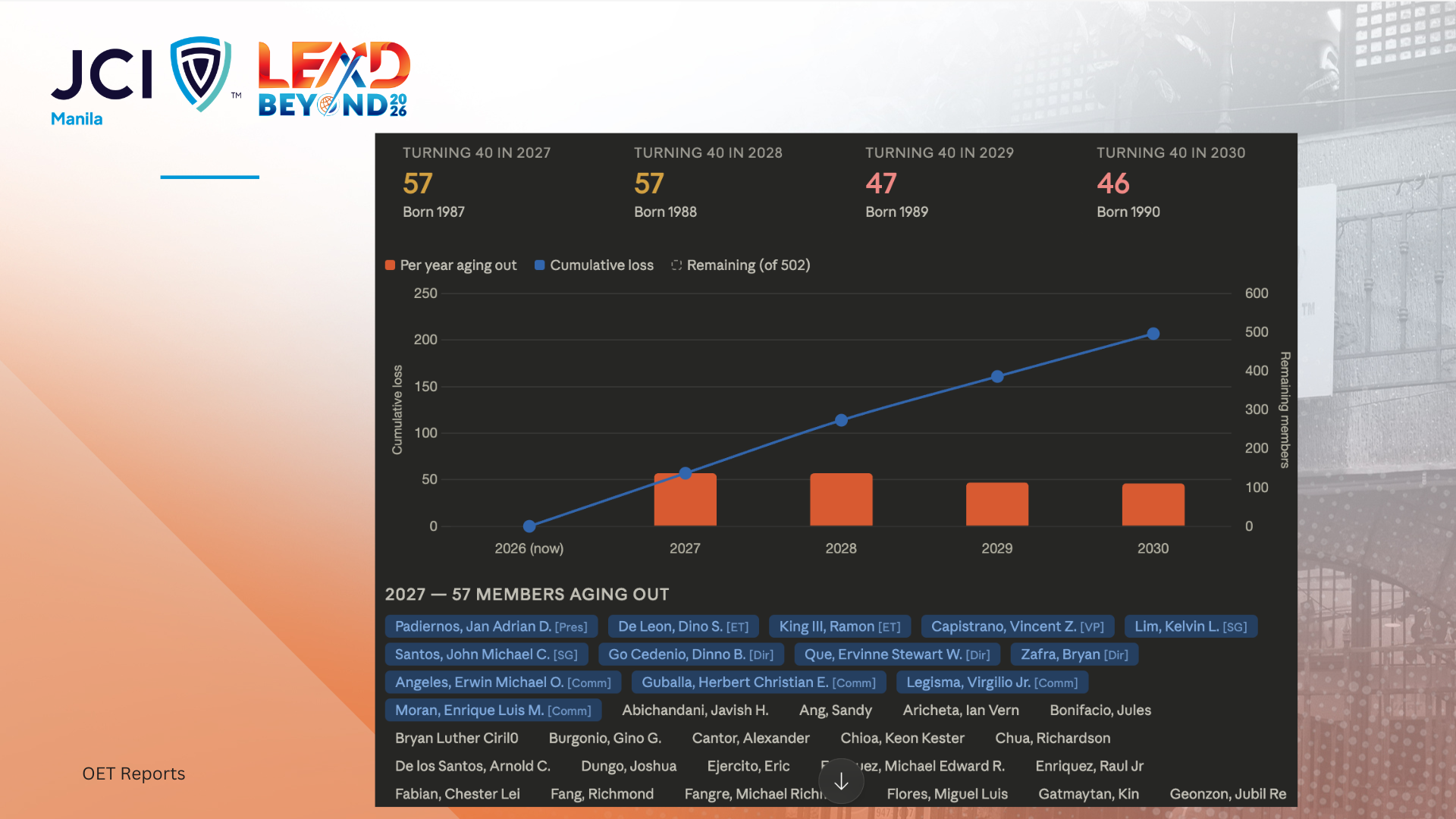
The most immediate concern is a coming wave of members aging out.
Starting in 2027, at least 57 members are expected to exit due to age limits. The same number is projected in 2028, followed by continued losses through 2030. In total, more than 200 members could leave within four years.
These are not just ordinary members. Many belong to the leadership core, including past presidents, board members, and senior members.
The scale and timing suggest more than routine turnover. It points to a potential leadership gap.
Organizations often struggle not when members leave, but when experience and institutional knowledge leave all at once.
Preserving What Leaves
This is where documentation becomes critical.
As a publication, Asian Pearl plays a role that goes beyond reporting. It serves as the chapter’s record of decisions, projects, and leadership perspectives across different years.
In periods of transition, this record becomes a reference point. It allows new leaders to understand not only what was done, but why it was done.
Without that continuity, organizations risk repeating past efforts instead of building on them.
At the same time, recruitment and training efforts take on greater urgency.
Programs such as Limitless are designed not only to bring in new members, but to integrate them into the organization’s culture and values. The goal is to ensure that incoming members are prepared to assume roles that outgoing leaders leave behind.
In this context, recruitment is not simply about growth. It is about continuity.
A Network Centered in Metro Manila
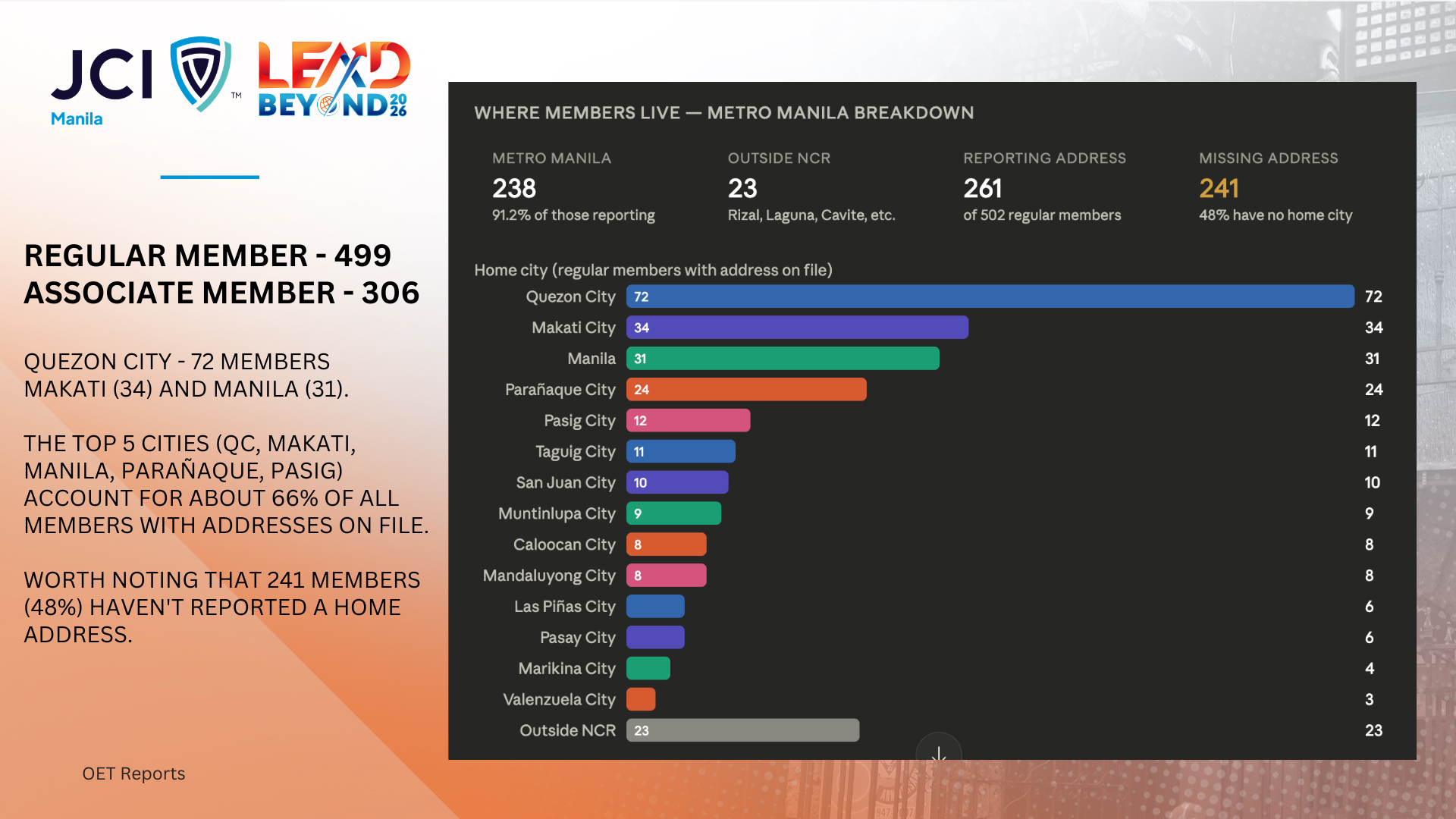
The data also shows a clear geographic pattern.
Most members work within a corridor that includes Quezon City, Makati, Taguig, and Pasig. Residential data reflects a similar concentration.
These areas are among the country’s main business districts. The clustering indicates that JCI Manila operates within the center of economic activity.
This positioning gives the organization access to capital, partnerships, and influence. It also raises a question about reach.
A network concentrated in a few areas may need deliberate strategies to extend its impact beyond them.
Entrepreneurial by Structure
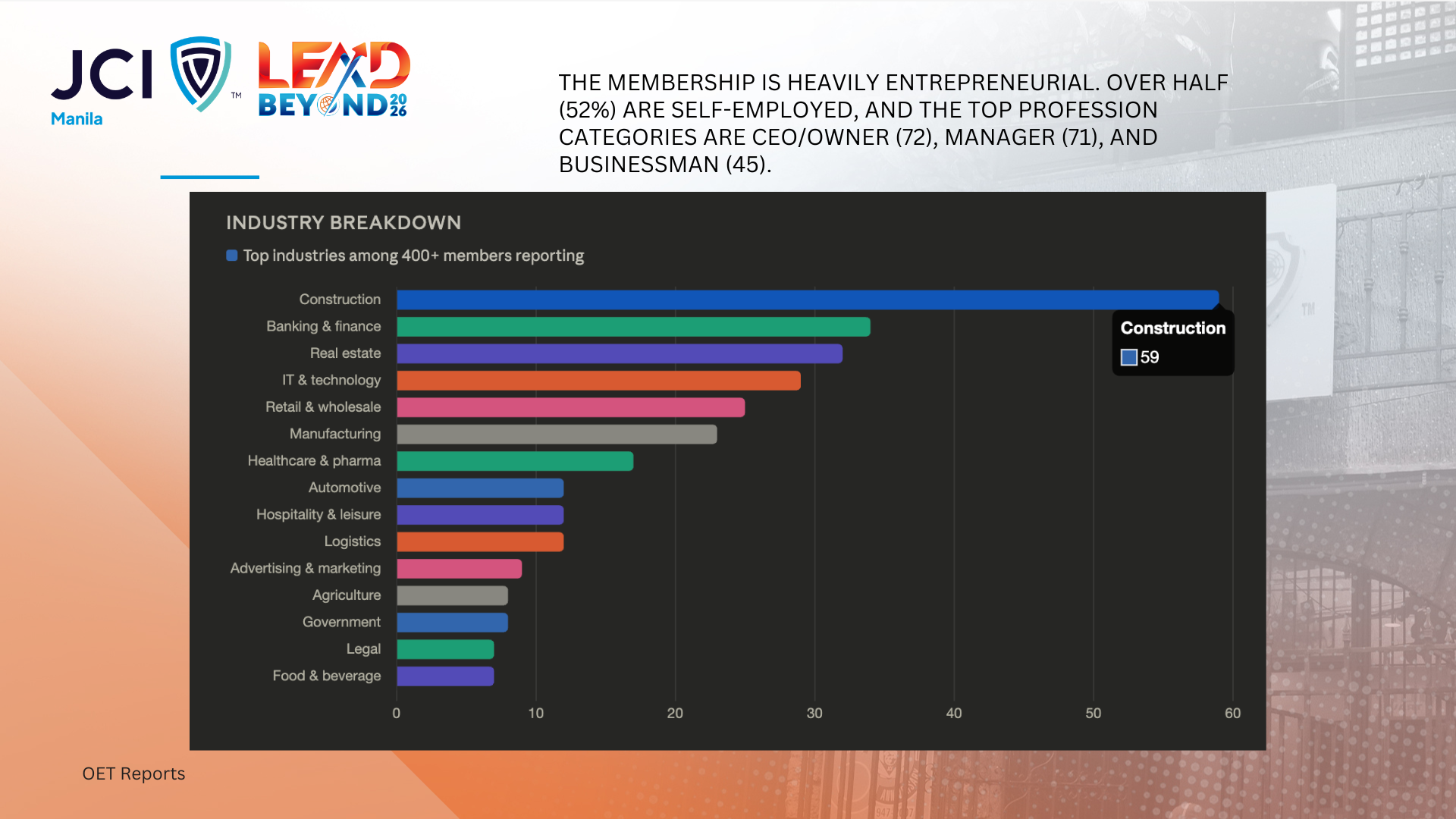
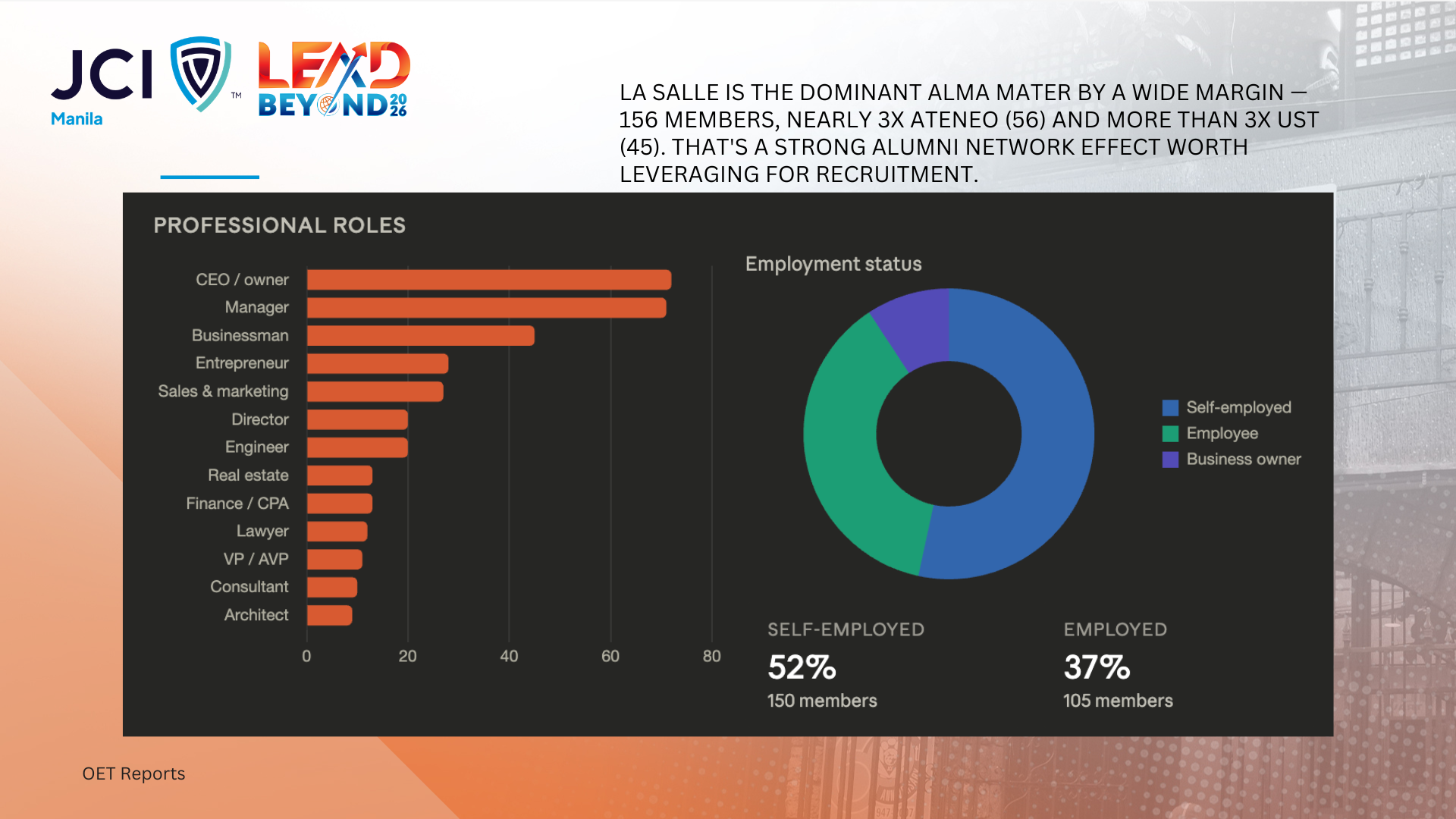
More than half of the members are self-employed. Common roles include chief executive officer, business owner, and manager.
This suggests that the organization is made up largely of individuals who make decisions within their own enterprises.
Such a structure has advantages. Members are not only professionals. They are also operators who can act on opportunities.
The challenge is how to align individual capacities toward collective goals.
The industries represented in the membership further highlight this potential.
Construction leads, followed by banking and finance, real estate, and information technology. These sectors are central to infrastructure development and economic growth.
JCI Manila is not only discussing development. Its members are directly involved in it.
The question is whether these connections can be mobilized in a coordinated way.
Alumni Networks as Growth Channels
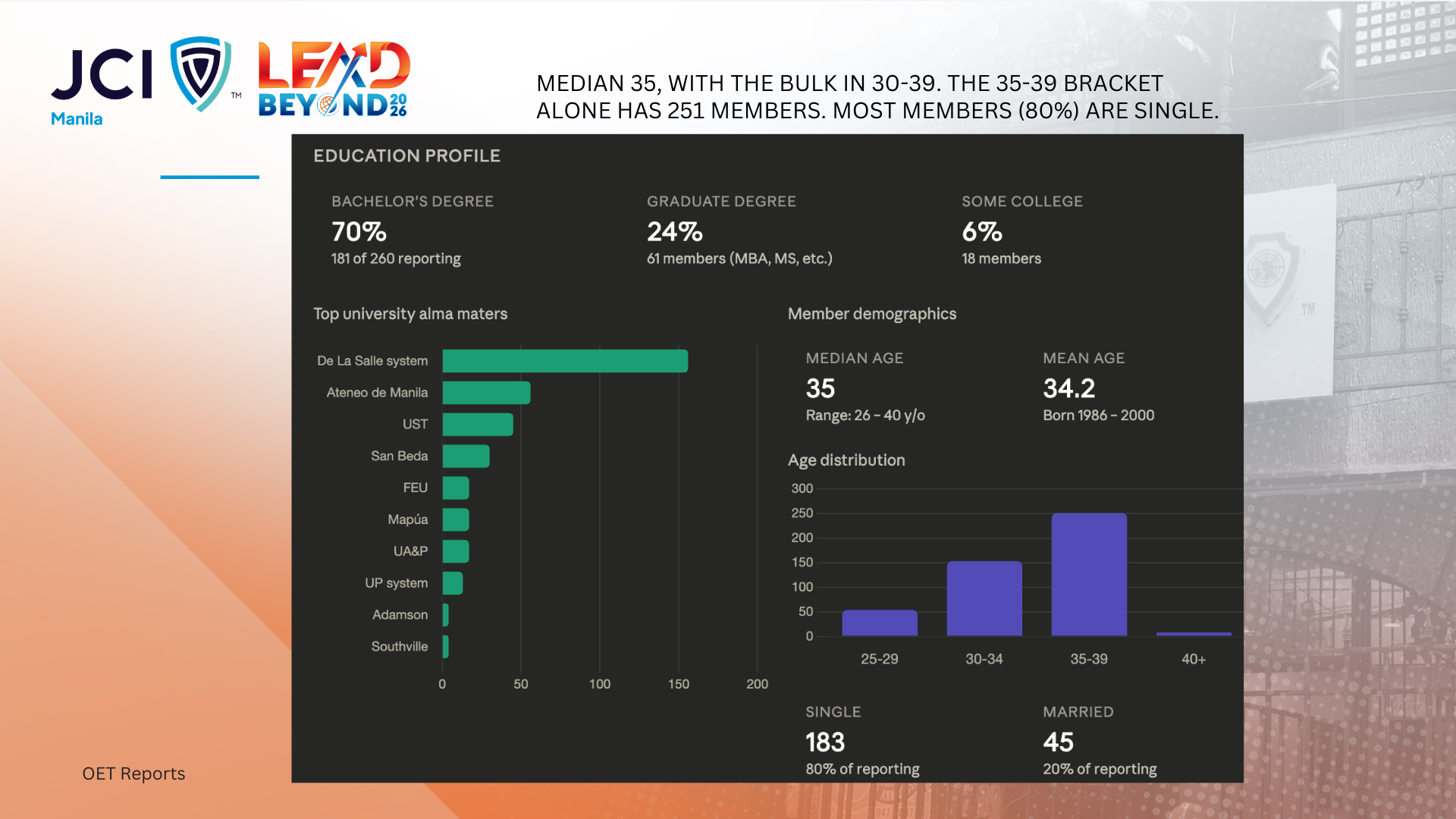
Educational background provides another layer of insight.
De La Salle University accounts for the largest share of members, with 156. Ateneo de Manila University and the University of Santo Tomas follow at a distance.
At the same time, other institutions such as San Beda University, along with FEU, Mapúa, and UP, maintain a steady presence.
This distribution reflects how recruitment often follows existing networks. Alumni connections provide familiarity and trust, making them effective entry points for new members.
These networks can be expanded further if approached intentionally.
Members in Their Prime
The median age of members is 35, with most falling between 30 and 39 years old. A large majority are single.
This demographic profile indicates that many members are in a stage of career growth and business expansion.
They are in a position to take on leadership roles and pursue larger initiatives.
For the organization, this represents a window of opportunity.
A Gap in Participation
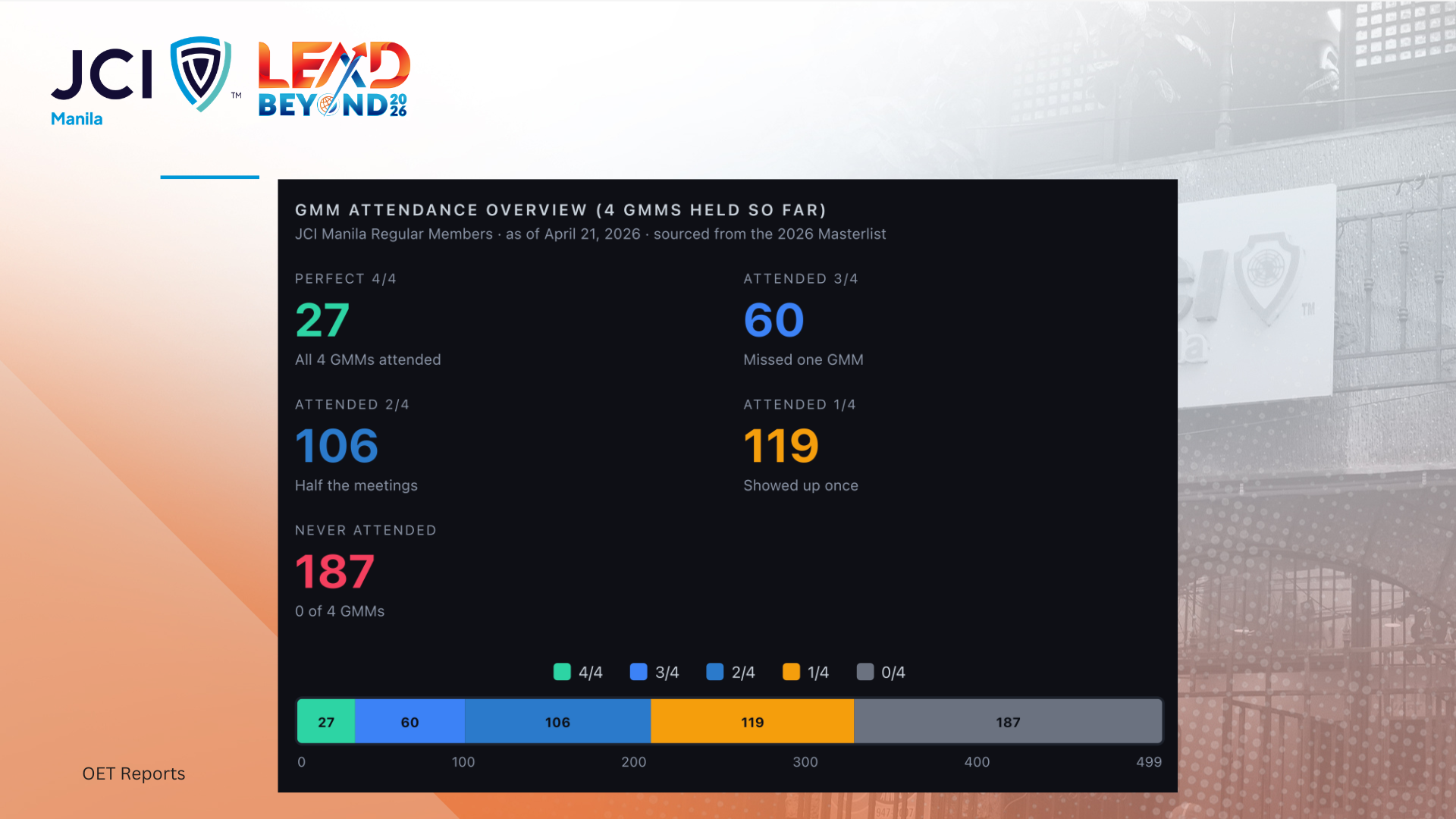
Despite these strengths, participation levels raise concern.
Only a small number of members attend all General Membership Meetings. A much larger group attends occasionally, while 187 have not attended any.
This indicates that a significant portion of the membership is not actively engaged in the organization’s core activities.
Low participation can affect cohesion, communication, and the ability to execute programs.
Signals from Financial Data
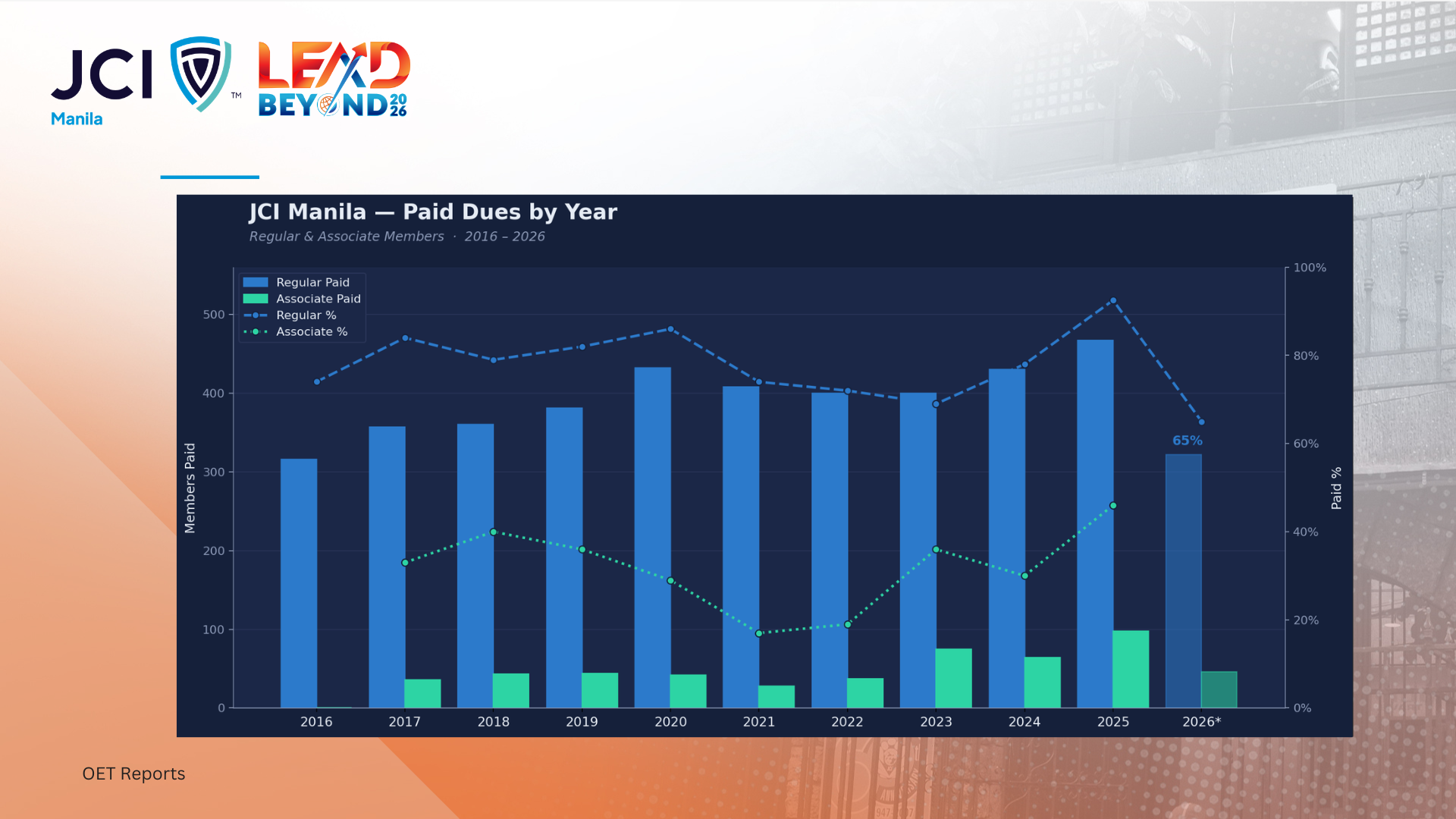
Membership dues provide another indicator of engagement, but require careful interpretation.
Initial readings suggested a decline based on comparisons with previous years. However, this was based on partial-year data for 2026 measured against full-year figures from prior periods.
According to Executive Treasurer Joshua Aragon, dues collection as of January 2026 has reached approximately 60% of members, higher than the roughly 50% recorded at the same point in previous years.
This suggests stronger early compliance rather than decline.
The more relevant question moving forward is whether this early momentum can be sustained throughout the rest of the year.
Incomplete Member Data
Nearly half of the members do not have recorded home addresses.
This limits the organization’s ability to fully understand and engage its base.
Accurate data is essential for planning events, outreach, and communication. Without it, efforts may not reach their intended audience.
Looking Ahead
JCI Manila remains a strong organization with a network of capable individuals across key sectors.
The insights presented by Executive Treasurer Joshua Aragon offer a clear and timely picture of where the organization stands.
A large group of leaders will exit in the coming years. Participation levels vary widely. Some member data remains incomplete.
These are not immediate threats, but they are indicators.
They point to areas that require attention, planning, and action.
Strength provides a foundation.
How the organization responds to these signals will determine whether it can sustain that strength in the years to come.
SEO by SEO-Hacker. Optimized and maintained by Sigil
© 2026 Asian Pearl. JCI Manila Official Publication. All Rights Reserved.